
Speakers:
-
- Dr. Ben Manski, Next System Studies at George Mason University
- Suren Moodliar, Encuentro 5
- Dr. Kathryn Milun, University of Minnesota Duluth
- Lizah Makombore, Leadership for the Ecozoic Fellow and PhD candidate at the University of Vermont
- Dr. Aimee Loiselle, Scholars for a New Deal for Higher Education and West Virginia University
- Chris Lopez, Southern Connecticut State University
Facilitated by Dr. Deissy Perilla and April Doner, Center for Next System Studies
This session of the Next System Teach-Ins Organizer Workshop Series was a practical and energizing deep dive into the logistical realities of building a Teach-In from the ground up. If you weren’t able to make it – or you want to continue the discussion – below is a full recap and some action steps we invite you to take with us as we build toward a global wave of Teach-Ins in 2027.
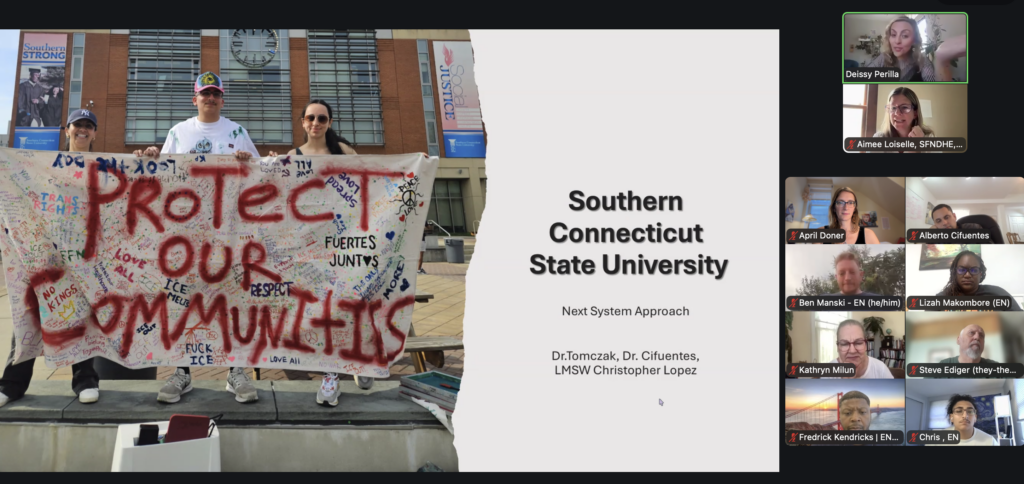
Facilitator, Deissy Perilla, speaking at “Practical First Steps for Organizing Your Teach-In”
RECAP
Story of Practice – the Potential of Teach-Ins
Dr. Ben Manski, Director of the Center for Next System Studies, opened by sharing the history of the very first Next System Teach-In at UC Santa Barbara. Drawing from his experience organizing Democracy Teach-Ins in the late 1990s, Ben described how a small team built a coalition of 150–200 campus and community organizations and organized an event that drew 2,000 participants in just four months.
The organizing process was highly structured, with detailed spreadsheets tracking outreach across hundreds of organizations. A steering committee met weekly, with representatives from unions, student associations, academic departments, and community organizations all formally signing on. The event itself featured major plenaries with diverse political perspectives, faculty bringing classes to boost attendance, and multiple formats including workshops, film screenings, participatory art-making, and a street fair.
“This is the kind of thing you do with any kind of serious organizing thing, right? You do the work of building community and building strategy and maximizing all the knowledge and strategies people have.”
— Dr. Ben Manski
Framing Your Organizing: Logistics, Audience, and Stages
Suren Moodliar of Encuentro 5 offered a framework grounded in 60 years of teach-in experience, emphasizing that all organizing work revolves around two core questions: logistics and audience—both understood through the lens of your movement’s stage of development.
Suren explained that all stages of organizing are always in play, though their relative weight shifts over time. He encouraged organizers to be “opportunists with principles”—unsentimental about logistical questions—choosing venues, outreach strategies, and promotional materials based on what works for target groups. A practical approach is working backwards from your teach-in date: set objectives, identify who needs to be there, determine venue needs, and build your timeline accordingly.
Essential questions every organizer should ask:
-
- Who is your audience?
- Will they help you get things done?
- Can they help with funding or fundraising?
- Could their department or union partner to host the event?
Navigating Institutional Barriers & Securing Funding
Dr. Kathryn Milun shared how she organized multiple teach-ins at UMD, securing funding entirely through university sources. She applied for small grants ($1,500–$3,000) through community-engaged work programs, noting the challenge that funding often arrives just before or after the event.
She engaged students as partners and co-leaders by including upper-division students on the steering committee while large introductory classes attended as part of their final assignments. Her teach-ins integrated music (bluegrass bands), food, art, and Indigenous perspectives including Winona LaDuke and others in the 1854 Treaty Area. She used participatory techniques like World Café discussions and always thought of each teach-in as a milestone for community change.
“Always thinking of it, as Suren said, as a kind of milestone for community change that we wanted to happen afterwards that we could actually build on.”
— Dr. Kathryn Milun
Lizah Makombore | Leadership for the Ecozoic, UVM
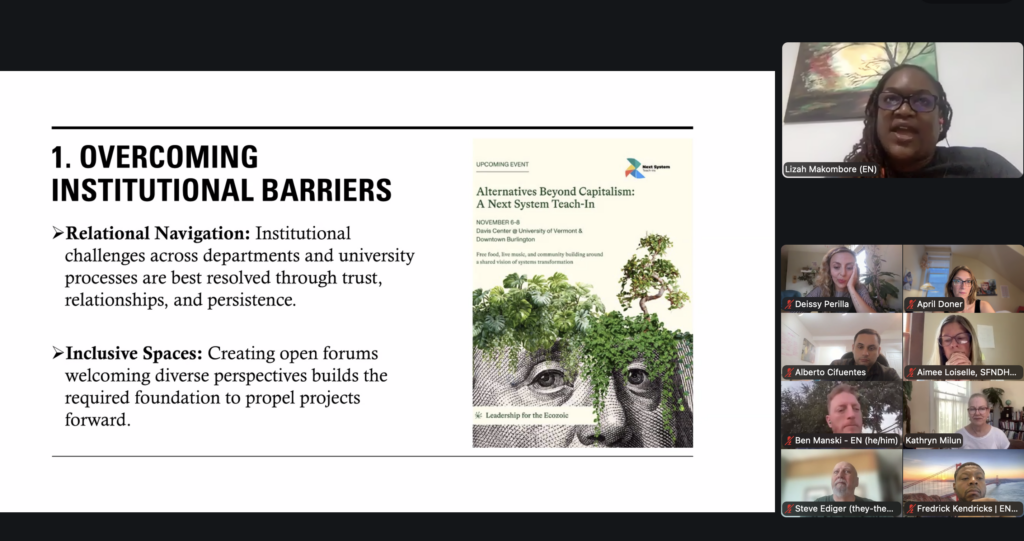
Speaker, Lizah Makombore, at “Practical First Steps for Organizing Your Teach-In”
Lizah Makombore shared reflections from a multi-day teach-in at UVM, focusing on navigating diversity of thought. Her team started with a comprehensive spreadsheet mapping potential partners across departments and community organizations. She found that meaningful collaboration doesn’t require everyone to agree from the start—it requires openness, respect, and a shared commitment to learning together.
The team secured funding through student internships over the summer, allowing them to pay stipends, reach out to guest speakers, cover venue costs, and support community partners. They created inclusive spaces with food, music, and a “harvest room” for diverse learning styles, moving beyond traditional conference formats.
“Funding wasn’t just about, you know, covering costs. It was also a process of how we collaborated—a process of how we made collaboration possible”
— Lizah Makombore
Creating inclusive spaces:
-
- Provided food (pizza!) to attract and retain students
- Included music and a “harvest room” (arts/crafts space) for diverse learning styles
- Moved beyond traditional conference-style formats
- Ensured all forms of learning were honored
Voices from the Ground: Teach-ins, Organizing Coalitions & Open Spaces
Dr. Aimee Loiselle, a labor historian at West Virginia University, offered practical insights from labor and feminist organizing. She emphasized the importance of a short, quick “hook” to grab attention, followed by a slightly longer “pitch.” She cautioned against assuming people agree with you—the most successful movements think about the people least likely to join.
She stressed the importance of one-on-one outreach, developing accessible tools (scripts, pre-addressed postcards, fill-in-the-blank templates), creating shared activities at all levels, and building both internal culture (bonding among those who agree) and external culture (media and pop-culture outreach).
“How do you get your message out to the general public, what I call the mainstream audiences that are not at your event but that you want at the next one?”
— Aimee Loiselle
Chris Lopez shared creative, low-budget engagement strategies from a teach-in at Southern Connecticut State University. His team created a community banner where participants wrote poems, words, and drew pictures—a collective artifact that sparked conversation. They used music with a DJ, live screen printing where participants took home custom items, and food to bring people together.
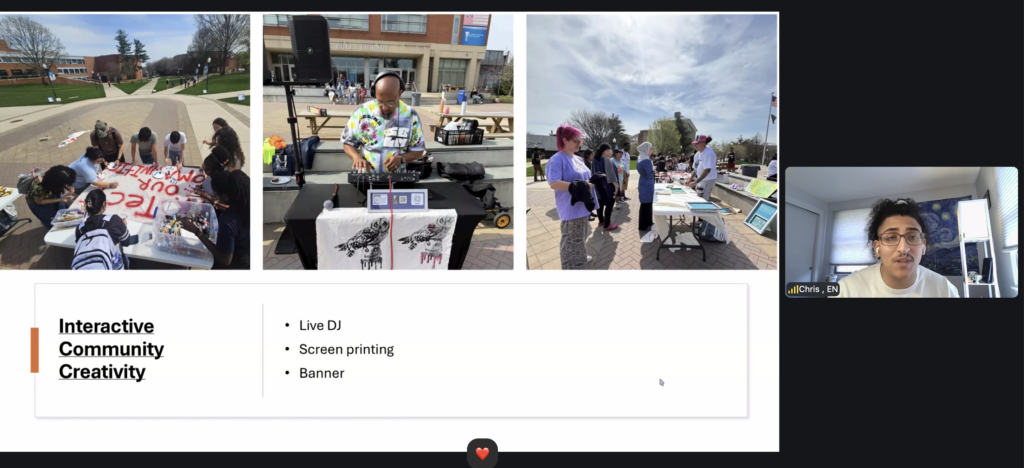
Speaker, Chris Lopez, at “Practical First Steps for Organizing Your Teach-In”
Chris emphasized that resistance takes many modalities—kindness, community, and joy are all forms of resistance. He noted the importance of giving energy a direction through follow-up events and creating FOMO (Fear Of Missing Out) through intentional social media sharing. Even without significant institutional backing, his team pivoted and created a meaningful event.
“Resistance doesn’t look like one thing. So we want to expand it and creativity is an underutilized form of resistance.”
— Chris Lopez
Breakout Conversations: Organizing in Action
Participants broke into small groups to discuss three prompts:
-
- What’s one organizing practice, value, or idea you heard from our panelists that you want to bring into your own Teach-In?
- Who is the audience your Teach-In most needs to reach — and who is one partner or ally you haven’t approached yet who could help you get there?
- What’s the single biggest barrier (institutional, logistical, or resource-related) in your way right now, and what’s one next step you could take on it this week?
Participant Reflections
“I was in a conversation with Frederick from Chicago who’s a high school teacher. So it blew my mind—and we’ve already exchanged information and we’re going to be communicating.”
— Jeff, Virginia
“Just the feeling of instant connection and cooperation and how much you can get done when you’re all in the same place for the same reason.”
— Rachel, West Virginia
“I was in a small group where I was able to provide a link to an experience in the United States even though I’m from Argentina to people who are activating and doing things in the United States.”
— Ana, Argentina
What’s Next & Updates
The path to the April 2027 wave of Next System Teach-Ins is already unfolding, and your participation is essential to making it a success. Whether you’re ready to launch a new teach-in or grow an existing one, you can stay connected with our community of practice and keep weaving this process together with others taking responsibility for system change around the world.
Additionally, in response to requests from organizers, we’re soft-launching a map of confirmed teach-ins, as well as an atlas of Next System projects and organizations to help you connect with others in your region.
Action Steps
-
- SIGN ON TO THE CALL for Next System Teach-Ins, where you can also let us know the role(s) you want to play: organizing a local teach-in in your area, participating in one, and/or involving your organization. When you sign, please select “participate in organizing a teach-in” if you’re interested—we’ll add you to a listserv for organizers to connect and share ideas.
- SAVE YOUR SPOT for the next NSTI Organizer Workshop on October 30th, “Wall-to-Wall Organizing: Campuses, Schools & Universities.”
Workshop Artifacts
Key Resources
Get Support
Not sure where to start? The CNSS Team is here to support your planning process all along the way. We offer direct consulting, coaching, and help connecting you with others in your area who are also working toward a next system and may be interested in partnering with you.
Email us: dperilla@nextsystem.org
And last but not least, a sincere thank you to The Interpreters’ Cooperative for their essential work in ensuring that this event remained accessible and honored the internationalist orientation of the Next System Teach-Ins.