
Speakers:
-
-
- Dr. Ben Manski, Next System Studies at George Mason University
- Lili Deveneau, George Mason University
- Suren Moodliar, Encuentro 5
-
Facilitated by Dr. Deissy Perilla and April Doner, Center for Next System Studies
Teach-In Coaches: Matt Burke (UVM), Lizah Makombore (UVM), Lesley Wood (York), Kathryn Milun (UMD), and Ana Ines Heras (UNSAM)
Recap: Wall-to-Wall Organizing for System Change
October 30 Workshop Explores Building Broad Participation Across Campus and Community
In a highly participatory session facilitated by Deissy Perilla and April Doner, and featuring speakers Suren Moodliar (encuentro5), Lili Deveneau (George Mason University), and Ben Manski (Next System Studies), participants explored how Teach-Ins can create openings for people who don’t usually organize together. The workshop, which included lively Q&As, breakout rooms, and open space dialogue, focused on building broader participation across roles, departments, and status divides on campuses—and extending that organizing beyond institutional walls.
Mapping the Campus, Building Relationships
Suren Moodliar opened with a call to think systematically about who is on campus and how to connect with them. “When we think about those huge movements, one of the things that’s really inspiring about them is their breadth and their strength,” he said. “It’s hard sometimes to think about these movements and realize that they begin with the kinds of relationships that we build every day on campus.”
Moodliar emphasized the importance of mapping—identifying not just students, staff, and faculty, but understanding the many subgroups within each category. “Rather than seeing these as infinite divisions, we need to see these as bridges which we can work with to involve people,” he explained.
He offered concrete examples: “Toronto Metropolitan University has pioneered a great system in which the campuses are connected to local suppliers and vendors… Emory University in Atlanta created a rubric for sourcing of foods—generally the more local the better, the more independent and cooperative the better.”
Planning for Participation
Lili Deveneau shared practical strategies from the George Mason University organizing committee. “The organizers are really the heartbeat of the teach-in,” she said. “The more that we can think about their skills and strengths, their goals and their communities that they’re a part of, the easier it’ll be to plug them into the roles.”
Deveneau stressed the importance of meeting people where they are: “Think about where your dream presenters and your dream participants are and meet them where they are and invite them in.” She also offered a grounded reminder: “Transformation can be messy. So can organizing.”
Wall-to-Wall Organizing as a Mentality
Ben Manski framed the workshop’s theme as a philosophy rooted in the labor movement. “The mentality of wall-to-wall organizing is one which those of us who come out of the labor movement… is a mentality that unions have when we go out to organize everybody,” he said. “Everybody who was within the walls of the factory should be in one union.”
Applied to campuses, he explained: “Our goal wherever we’re starting from is to get to the point that we’ve had conversations with everybody… We’re going far beyond the choir and we’re putting the question of system change in front of as many people in as many communities as possible.”
Participant Dialogue: Finding Common Ground
During the Q&A, participant Lydia from Virginia asked how to start conversations with people using different language. Deveneau responded: “Talk about something from their work that is aligned and then go from there and allow that common language to come into play.”
Manski added that the Next System framework functions as “a kind of frame of frames for a movement of movements.” He noted that “there’s all kinds of system change work that is happening… in all kinds of different frames.”
Participant Maru Louisa, an adjunct faculty member with community organizing roots, offered a practical tip: “A starting point might be those that have something called community engagement… led by faculty who are trying to connect students to community.”
Katherine from the University of Minnesota Duluth shared how her community organized around energy transitions: “You can then invite somebody who’s done that work successfully in another community to be and organize it as a workshop and then frame the whole as next systems because this is one of the systems.”
Breakout Rooms: Fear, Funding, and Moving Forward
In the breakout rooms, participants tackled topics including outreach, campus labor organizing, navigating institutional repression, and funding strategies.
One group discussed the importance of not letting fear silence organizing: “Don’t ever let the vibe of fear that’s around you not allow you to be able to organize in a way that you can speak on what is important to people.”
The funding group explored tapping into community resources—local folk music and theater, faith-based organizations, libraries, cooperatives, and even legacy gifts. One participant noted that in Argentina, “cooperatives of workers have to put 5% of their budget into educational activities by law.”
Looking Ahead to April 2027
Deissy Perilla closed with a call to action: “Everything that we are working on… points toward one thing and one plan, which is the April 2027 wave of teachings.” She encouraged participants to “join the April 2027 wave,” “launch your own local teachings,” and “keep weaving this process with other organizers and groups.”
As April Doner reminded everyone: “Transformation can be messy. So can organizing.” But as this workshop demonstrated, the work of building a next system—relationship by relationship, conversation by conversation—is already well underway.
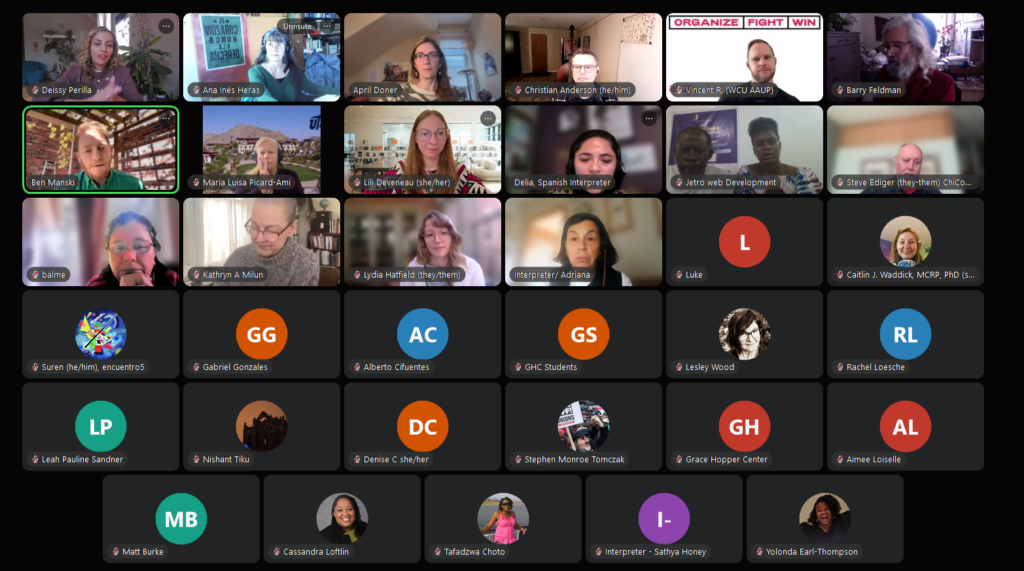
Open discussion at “Wall-to-Wall Organizing: Schools, Campuses, & Universities”
We encourage you to keep taking action with these steps:
- SIGN ON TO THE CALL for Next System Teach-Ins, where you can also let us know the role(s) you want to play: hosting a local teach-in in your area, participating in one, and/or involving your organization.
- SAVE YOUR SPOT for the next NSTI Organizer Workshop on “Building worldwide solidarity, facing the crisis,” on December 4th.
- CHECK OUT THESE MAPS-IN-PROGRESS confirmed teach-ins and an atlas of projects and organizations who are advancing the Next System to connect with others in your region working toward the next system.
- Explore the Resources below to support and inspire your local organizing
Two massive thank yous: to our coaches Matt Burke, Lizah Makombore, Lesley Wood, Kathryn Milun, and Ana Ines Heras, who shared their time with us to offer advice and insights into how to organize a teach-in and last but not least, to The Interpreters’ Cooperative for their essential work in ensuring that this event remained accessible and honored the internationalist orientation of the Next System Teach-Ins.
WORKSHOP ARTIFACTS:
TEACH-IN ORGANIZING RESOURCES
to inspire, support and inform your local organizing in your community or campus:
- NS Teach-Ins Organizing Guide
- NS Teach-Ins Organizer Workshop Series on YouTube
- Videos: 2025 Next System Convergence & Organizing Conference, including “Introduction to the Next System Teach-Ins,” “Campuses & Communities: Sharing Teach-In plans, ideas, and questions,” and “How to Organize a Teach-In.
Not sure where to start? The CNSS Team is here to support your planning process all along the way. We offer direct consulting, coaching, and help connecting you with others in your area who are also working toward a next system and may be interested in partnering with you. To connect with us, email: dperilla@nextsystem.org
INFO & INSPIRATION FROM PREVIOUS NSTI WAVES
- Videos from local 2025 NS Teach-Ins
- Report: “A Wave Across the Americas: Next System Teach-Ins”
- Articles: “Organizers at Global Teach-ins Seek Solutions and Envision What Comes Next” | “What Comes After Capitalism? Upcoming Teach-Ins Can Show a Way Forward”
To learn about and register for upcoming workshops, see the NSTI Organizer Workshop Series