
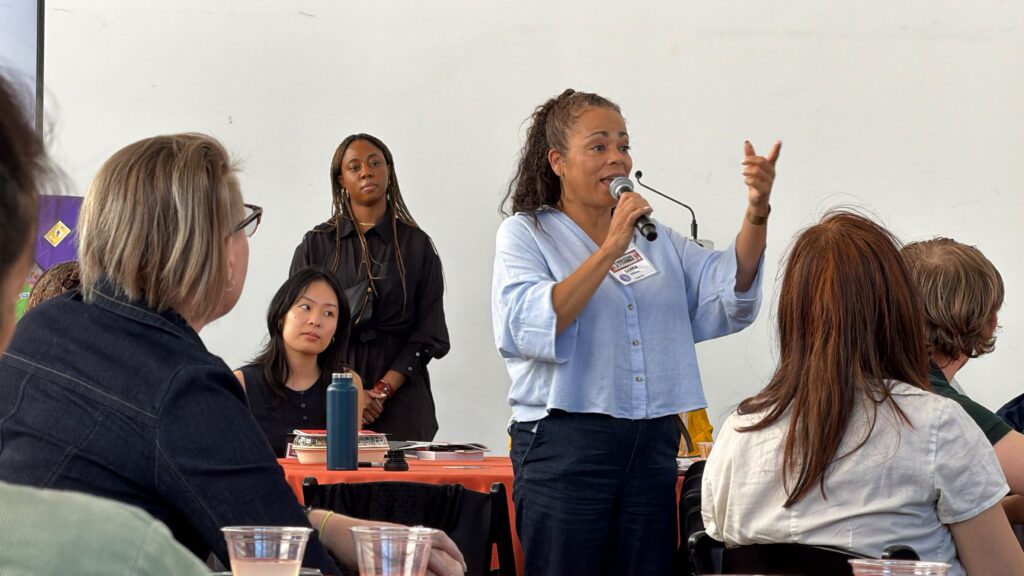
Participant sharing their thoughts with the convening
On July 30th, 2026, Next System Studies (NSS) sent delegations from Northern Virginia, Chicago, and the Bay Area, including students, alumni, faculty, and staff, to Berkeley, California for the Center for Cultural Innovation’s (CCI) convening: A Better Future is Possible. Our Next System contingent–which included Abigail Naidoo, April Doner, Dhruv Deepak, Fabian Palacios, Gabriel Gonzales, Isabella Villota, and Pearl Renwick–engaged with concrete actions for building a “better-together” future, examining how communities are already creating culturally rooted, community-owned systems across every domain of life, and explored why culture is essential to systems transformation. NSS was proud to partner with and support this gathering, which centered artists, creatives, and alternatives aimed at creating paradigm shifts in economic, social, labor, and creative models.
A centerpiece of the convening was the solidarity fair, where dozens of organizations shared their projects and practices across sectors including art and culture, education, food and agriculture, health and care, media and information, business and worker ownership, finance, land and housing, participatory democracy and mutual aid, and utilities and energy. Among the many offerings, the School of the Art Institute of Chicago presented their work on new strategies for arts education; The Big We shared their efforts to build a cultural economy in Memphis and the South; Cooperation Richmond highlighted their model for building cooperative ownership so residents claim ownership of the local economy; and NSS offered its own framing on the role of universities, colleges, schools, and communities in taking responsibility for system change.
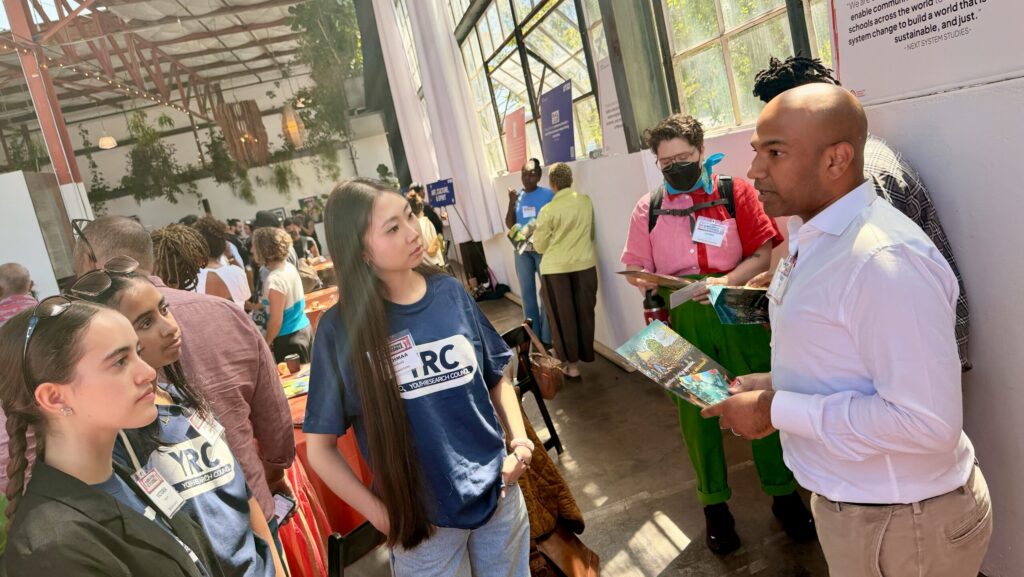
Dhruv Deepak (NSS at GMU) speaking with the Youth Research Council student delegation
The second half of the day invited attendees into the World Building Design Lab, an interactive session building upon the capacity building tools and processes designed by Beautiful Trouble. Participants chose between different scenarios linked to a spectrum of social, community and economic sectors including finance, health and care, utilities and energy, and land and housing. Groups were tasked with designing cooperative and community-centered solutions. Using principles from the Beautiful Solutions book and Strategy Cards Deck, teams developed creative responses that prioritized community flourishing and demonstrated, in real time, how a better future is possible. At every turn, the gathering showcased a vibrant ecosystem of organizations working to build cooperative, community-owned alternatives across every sector of society.
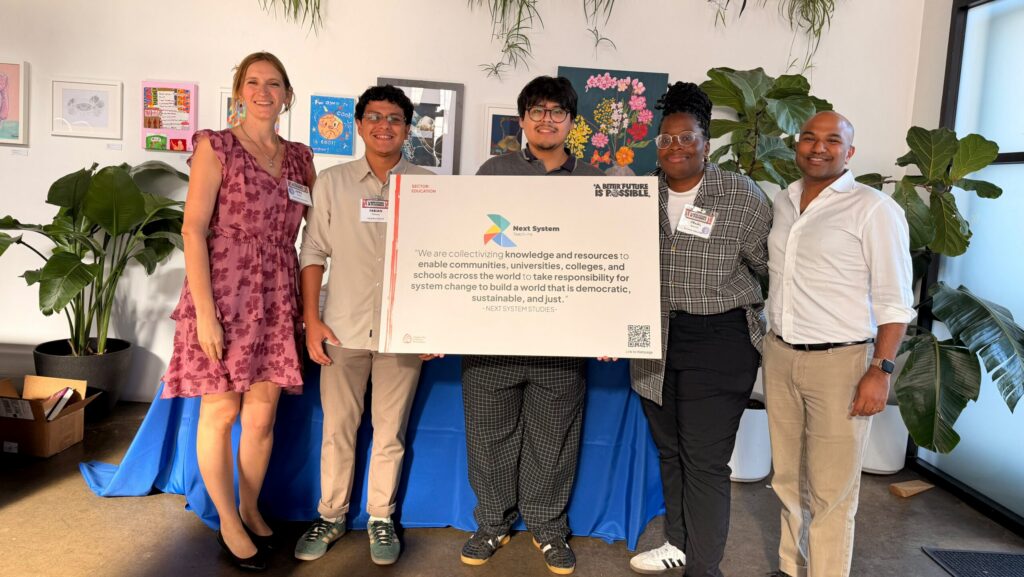
April Doner, Fabian Palacios, Gabriel Gonzales, Pearl Renwick, and Dhruv Deepak (from left to right)
For many in our cohort, presenting NSS outside the relative comfort of a lecture hall and into a practitioner environment was a significant shift. While initially we expected academic frameworks to be met with skepticism, the reception proved strikingly positive; several colleagues noted a genuine appetite for our conversations. The convening—holding policy advocates, technologists, artists, grassroots organizers, and community leaders—reinforced in us the belief that building a better world is not confined to academic theory but is already being worked out daily by real people of all walks of life.
NSS alumni Isabella Villota noted that the gathering “made me even more hopeful for our future and what a next system can look like. The people I met had done such amazing work, and that inspired me to pursue putting myself out there in more events like CCI. It also pushed me to do research in my area to see what I can do to help and learn more about local grassroots/activist organizations.”
Additional takeaways shared by the NSS team included:
-
-
-
-
- There’s so many people doing amazing work in so many different ways (A. Naidoo)
- Solidarity exists, you just have to find it. (A. Naidoo)
- The importance and value of networks and relationships. I’ve met people I knew threw someone else and all these connections are essential to organizing and building alternatives. (A. Naidoo)
- Deep encouragement that this better future and world we want IS possible, and that creating warm, relational and bold spaces where we re-declare and explore what that means and looks like together is one of the key ways of birthing that world. (A. Doner)
- There are many people as interested and invested as we at NSS are in building the “connective tissue” and greater coherence and coordination among our various experiments, projects and networks! (A. Doner)
- System design is the future, and every angle should be looked at as a community (B. Villota)
- Community and that energy means everything when it comes to making things happen to actually help people (B. Villota)
- I can help even if my actions feel small; the efforts that I am apart of create a rift that flow in an ocean of people with my same mindset (B. Villota)
- ‘A better future is possible’ is not limited to theory of politics. I saw people from all walks of life and all abilities doing their part in that broader mission, including policy, tech products, art, advocacy, education. (D. Deepak)
-
-
-
Additionally, NSS Director of Field & Community Building, April Doner observed that the convening “clarified even more keenly the value and importance of academic / educational programs, frameworks and networks in helping bring about the cooperative and sustainable vision for our future. It reaffirmed how important the NSS at GMU program is in its work to integrate next system thinking AND real life application into the studies and aspirational imaginations of younger generations. It also reaffirmed how much bridge-building is still to be done between practitioner / movement / community spaces and those of academia, BUT that so many scholars are already thinking and building next system practices, relationships, and spaces of learning and deliberation in their own right.”
This opportunity to gather in intentional dialogue and prefigurative visioning with other “world-builders” provided our cohort with new and meaningful new relationships, perspective, and possibilities for partnership and collaborations going forward.
Dhruv Deepak reflects, “Talking about NSS in an external environment (we usually do so from the relative comfort of GMU) could have been intimidating, but I was struck by the positive reception. It gave me the sense that there is a broad appetite for the conversations we’re having at NSS and the direction that the work we’re doing is taking us.”